How many Questions in Duolingo English Test?
Each exam typically has about 45 to 60 questions across 13 different question types, but the Duolingo English Test (DET) does not have a fixed number of questions.
This comprehensive guide explains the frequency of each Duolingo English Test question type, describes key features of the exam structure, and presents real test data from three exams taken by the DETPractice team.
Duolingo English Test Question Types and Frequencies
The Duolingo English Test has been updated and now consists of 13 question types. The frequency of different Duolingo English Test question types varies. The number of questions for each type is not fixed for each test and for each individual test taker. Therefore, the experience of each Duolingo English Test is unique. However, all questions are designed to assess the four main language skills: listening, speaking, reading, and writing.
Reading Tasks in the Duolingo English Test
The reading section consists of four major types of questions. Together, these tasks assess your reading comprehension, vocabulary recognition, and ability to complete passages coherently.
| Task | Time | Frequency | Adaptive |
|---|---|---|---|
| Read and Select | 5 sec/word | 15-18 words | Yes |
| Fill in the Blanks | 20 sec/sentence | 6-9 sentences | Yes |
| Read and Complete | 3 min/passage | 3-6 passages | Yes |
| Interactive Reading | 7-8 min/set | 2 sets (6 questions each) | Yes |
Duolingo English Test Listening Tasks
The listening section comprises two main types of questions. It can be quite challenging for first-time DET test-takers, so you should prepare in advance and manage your time effectively during the test. You can participate in practice sessions and mock exams on the DETPractice platform, which can significantly enhance your performance.
| Task | Time | Frequency | Adaptive |
|---|---|---|---|
| Listen and Type | 1 min/sentence | 6-9 sentences | Yes |
| Interactive Listening | 6:30 + 75 sec | 2 sets | Yes |
Writing Tasks in the Duolingo English Test
The writing section includes three main types of questions. The Writing Sample is ungraded but is submitted to institutions. Similar to the speaking section, this part requires you to use a wide range of grammatical structures and vocabulary. In addition, do not limit yourself to the prescribed word count; express your thoughts more fully. Note that the Speak About the Photo, Read Then Speak, and Writing Sample tasks no longer have minimum time submission limits.
| Task | Time | Frequency | Adaptive |
|---|---|---|---|
| Write About the Photo | 1 min | 3 photos | No |
| Interactive Writing | 5 min + 3 min | 1 set (2 parts) | No |
| Writing Sample | 5 min (30 sec prep) | 1 | No |
Speaking Tasks in the Duolingo English Test
The speaking section consists of four major types of questions, including the Speaking Sample. It primarily assesses the test taker’s speaking fluency, clarity, and pronunciation. During the oral response section, test takers should aim to give as detailed and extended answers as possible within the limited time, using a wide variety of grammatical structures and vocabulary. Note that the Speak About the Photo, Read Then Speak, and Speaking Sample tasks no longer have minimum time submission limits.
| Task | Time | Frequency | Adaptive |
|---|---|---|---|
| Speak About the Photo | 90 sec (20 sec prep) | 1 | No |
| Read, Then Speak | 90 sec (20 sec prep) | 1 | No |
| Interactive Speaking | 35 sec/question | 6 questions | Yes |
| Speaking Sample | 3 min (30 sec prep) | 1 | No |
Why the Number of Questions Varies
Because it is an adaptive test, the questions each individual sees are different. Even if two test-takers receive a similar number of questions for each type, the actual items and difficulty levels will not be identical. If you want to achieve a higher score, it is important not only to be familiar with the various question types and their timing, but also to practice regularly.
Real Test Data from the Duolingo English Test: Three Exams Taken on July 1st
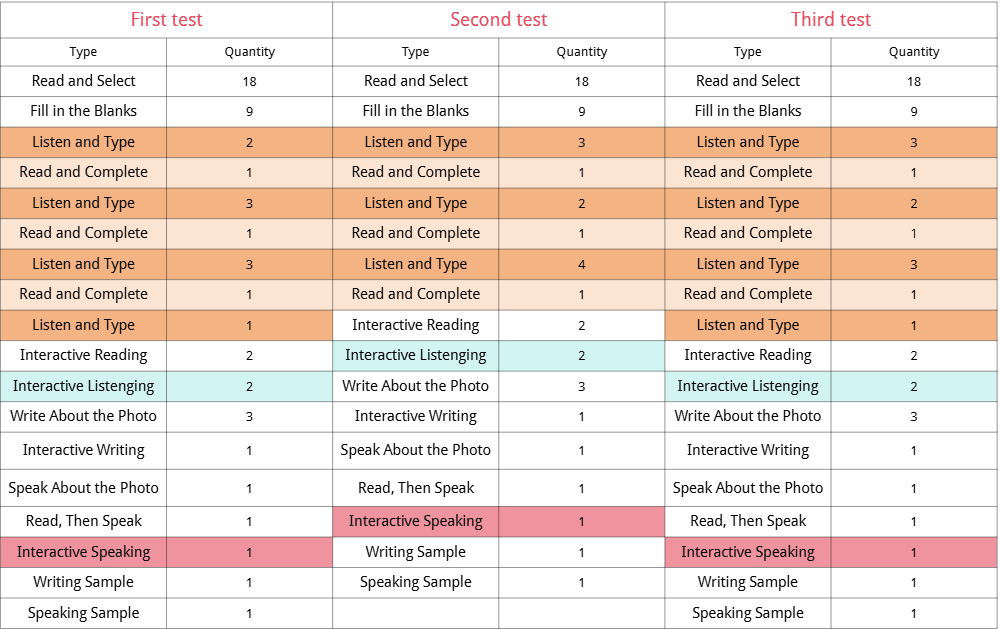
To provide test-takers with a more accurate understanding of the actual exam experience, the DETPractice team conducted three Duolingo English Tests on July 1st, following the major July 2025 update to the Duolingo English Test. The following data shows the actual distribution of question types encountered in each test, demonstrating the variability and adaptive nature of the exam. Although no two real tests are exactly the same, these results offer a helpful reference so candidates can better anticipate the overall structure and workload of the exam.
Duolingo English Test Structure and Features
The Duolingo English Test is an adaptive exam that typically lasts around 60 minutes. Unlike traditional in-person tests, the Duolingo English Test is conducted on an online platform, allowing candidates to take it from the comfort of their own homes or any location with a reliable internet connection. The Duolingo English Test consists of several key components:
1. Adaptive Test
This graded section of the Duolingo English Test covers a variety of question types, including reading, writing, listening, and speaking exercises. These questions are carefully designed to provide a comprehensive evaluation of a candidate’s language skills within the limited test duration. As demonstrated by the real test data above, the adaptive nature of the Duolingo English Test means that while certain question types remain consistent, others vary based on your performance.
2. Writing Sample
Candidates complete a writing task in 5 minutes (with 30 seconds of preparation time). The written response is included alongside the overall score report and shared with the schools or institutions to which the candidate applies. This task no longer has a minimum time submission limit.
3. Speaking Sample
Candidates respond to a prompt in 3 minutes (with 30 seconds of preparation time), and their recorded spoken response is also provided to the institutions. This task no longer has a minimum time submission limit.
The adaptive nature of the Duolingo English Test means the difficulty of the questions adjusts based on the candidate’s performance, ensuring an accurate assessment of their language proficiency. This design not only enhances the Duolingo English Test’s efficiency but also helps to reduce the stress typically associated with traditional exams.
Conclusion
The Duolingo English Test does not have a fixed number of questions, but real test data shows that the total usually ranges from 45 to 60.
For a comprehensive understanding of all question types and detailed preparation strategies, refer to the Duolingo English Test Guide 2026.
To prepare effectively, candidates should become familiar with all 13 question types and use practice tests to develop their responsiveness to different tasks, while also improving time management skills to succeed in this adaptive exam. Using practice tests on the DETPractice platform and developing strong time management skills are key to success in this adaptive exam.