
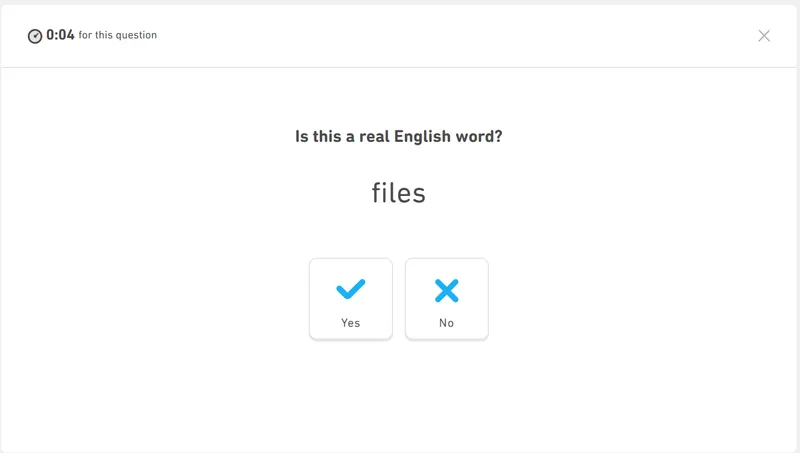
The Read and Select question type might seem incredibly simple at first glance. After all, you are just clicking "Yes" or "No" for a single word on your screen. However, this fast-paced section is actually one of the most powerful tools the Duolingo English Test uses to measure your true language foundation.
What is the purpose of this question?
Unlike traditional English exams that ask you to define a word or use it in a complex sentence, the DET uses a method called lexical decision making. The computer wants to see if you can instantly recognize the shape, spelling, and phonetic structure of genuine English vocabulary.
In the real world, when you read a book or listen to a university lecture, your brain does not have time to slowly translate every single word. You must process vocabulary automatically. By giving you exactly 5 seconds per word, the test measures this automatic recognition. If you truly know a word, 5 seconds feels like a very long time. If you do not know the word, having more time would only encourage you to guess blindly.
The Science of "Fake Words"
The most challenging part of Read and Select is not the real vocabulary—it is the cleverly designed fake words (pseudo-words). The test creators do not just type random letters like "zxgpt". Instead, they engineer fake words that follow the natural spelling and pronunciation rules of English.
There are three main types of traps you will encounter:
- Phonetic Traps: These are words that sound exactly like real English words when you say them out loud, but they are spelled incorrectly. For example, instead of the real word "physical", you might see "fizical".
- Morphological Traps: These fake words combine real roots with the wrong prefixes or suffixes. You might recognize the root word and think it is correct. For example, taking the real word "happy" and creating the fake word "unhappiment" instead of "unhappiness".
- Visual Traps: These are words that look extremely similar to high-level academic vocabulary but have one or two letters changed, such as "substancial" instead of the correct "substantial".
How Adaptive Difficulty Works
Remember that the Duolingo English Test is fully adaptive. You will evaluate between 15 and 18 words during your test session. When you correctly identify real words and successfully reject fake words, the computer algorithm immediately notices. The next word it shows you will be slightly more advanced.
You might start with simple words like "water" or "friendly". If you do well, you will quickly move on to advanced university-level vocabulary like "superfluous" or "ubiquitous". The test is trying to find the exact upper limit of your vocabulary size. If the words become incredibly difficult, do not panic! That is actually a great sign that you are performing at a high level.
Building Your Foundation
Because this question isolates your raw vocabulary size, the only true way to prepare is to read widely. Read English news articles, academic journals, and books. Expose yourself to correctly spelled English every day. While the practice strategies and tips provided below will help you avoid common traps on test day, your ultimate goal should be to build a rich, authentic vocabulary base.
