Duolingo English Test Question Type Intro 2:Writing Sample
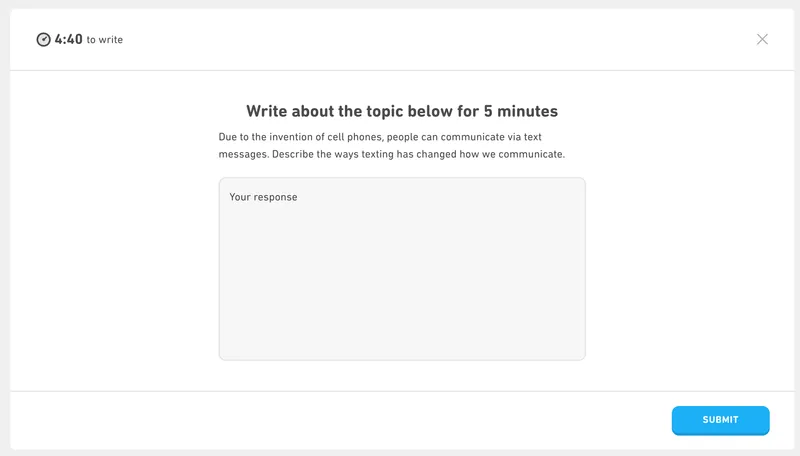
In the Duolingo English Test, the "Writing Sample" task requires you to respond to a related topic within 5 minutes. This blog post offers a comprehensive overview of the various types, categories, and strategies for tackling Writing Samples.
Understanding the "Writing Sample" Question Type
In the Duolingo English Test, the Writing Sample requires candidates to write a short response on a specific topic. This topic typically relates to daily life, education, technology, or other common subjects. This section is scored and counts toward your overall test score.
When you encounter this question type, you will first see the topic prompt displayed for 30 seconds before the 5-minute response timer begins.
As of 2025, the previous restriction requiring a minimum of 3 minutes before submission has been removed, giving you greater flexibility in managing your time. While there is no minimum word count requirement, we recommend writing at least 100 words to achieve a high score, as this length allows you to adequately develop your ideas and demonstrate your writing skills.
For more information about the July 2025 exam format changes, please refer to our article July 2025 Major Update.
Assessment Criteria for Writing Sample
The Writing Sample will be evaluated based on four key dimensions:
1. Content: This assesses how well you address the topic, your writing style, the logical progression of ideas, and your ability to engage the reader.
2. Writing Coherence: This evaluates the clarity and coherence of your expression, the smooth flow of context and transitions, and the overall structure of your writing.
3. Vocabulary: This measures vocabulary diversity, lexical complexity, word choice, word formation, and spelling accuracy.
4. Grammar: This examines grammatical complexity, grammatical accuracy, and proper use of punctuation.
Categories and Strategies in Writing Sample
Writing samples are generally divided into three main categories: descriptive questions, discussion questions, and comparison questions.
Descriptive Questions
Descriptive questions ask you to describe a personal experience, memory, skill, cultural tradition, or other topic in detail. These questions typically begin with prompts like "Describe a time when..." or "Write about something you recently learned."
Key Writing Tips:
1. Tense usage is crucial: Use past and perfect tenses when discussing experiences, movies, books, or past events. Use the future tense when expressing intentions or skills you wish to acquire.
2. Focus on grammar accuracy: Avoid overly complex sentences that merely showcase grammatical variety. Stick to constructions you're confident about.
3. Include vivid details: Incorporate the 5Ws (who, what, when, where, why, how) to make your description specific and engaging.
4. Use sensory details: Where appropriate, describe what you saw, heard, felt, or experienced to bring your writing to life.
Sample Question and Answer
Sample Question: Write about a cultural tradition or custom you recently learned about that interests you.
Sample Answer:
Recently, I've learned about the cultural custom of "Tea Ceremonies" in Japanese culture, an experience that has captivated me with its elegance and symbolism. This ritual, known as "Chadō" or "The Way of Tea," is more than a mere preparation of tea; it is a spiritual practice that emphasizes respect, harmony, purity, and tranquility. I discovered this tradition through a documentary that highlighted the meticulous movements and the contemplative atmosphere of the ceremony, which reflects the deeper values of mindfulness and hospitality. The intricate artistry and philosophical depth of the tea ceremony reveal a unique window into Japan's rich cultural heritage, making it a profoundly intriguing aspect of Japanese tradition.
Discussion Questions
Discussion questions require you to express and support your opinion on a topic. These often ask about your preferences, recommendations, or viewpoints on various subjects such as books, movies, hobbies, or life experiences.
Key Writing Tips:
· State your position clearly: Begin with a direct statement of your opinion without excessive introduction.
· Develop focused arguments: Choose 2-3 main reasons to support your position. Focus on common, relatable justifications rather than overly creative points.
· Use logical connectors: Words like "first," "additionally," "moreover," and "however" help clarify relationships between your ideas.
· Support with examples: Illustrate your points with brief examples, but avoid excessive detail given the time constraint.
Suggested Essay Framework:
· Introduction: State your opinion and preview your main supporting points.
· Body: Present 2-3 main arguments, each with supporting evidence or examples.
· Counterargument (optional): Briefly acknowledge an opposing view if time permits.
· Conclusion: Summarize your main points and reinforce your position.
· Important: With only 5 minutes, focus on ensuring your structure is complete rather than expanding every section fully.
Sample Question and Answer
Sample Question: Write about a book you enjoyed and explain why you would recommend it to others.
Sample Answer:
I highly recommend "The Alchemist" by Paulo Coelho to anyone seeking inspiration and meaning in life. First, the book's universal message about following one's dreams resonates with readers of all ages and backgrounds. The protagonist Santiago's journey teaches us that pursuing our personal legends requires courage and faith. Additionally, Coelho's simple yet profound writing style makes complex philosophical ideas accessible and engaging. The story's magical realism elements keep readers captivated while delivering life lessons. Moreover, the book encourages self-reflection and motivates readers to take action toward their goals. Whether you're facing a major life decision or simply seeking inspiration, this timeless tale offers valuable wisdom and hope.
Comparison Questions
Comparison questions ask you to analyze similarities and differences between two subjects, or to compare advantages and disadvantages of a single topic. These might ask you to compare two people, places, experiences, or approaches.
Key Writing Tips:
· Identify comparison points clearly: Determine what specific aspects you'll compare (features, benefits, characteristics, etc.).
· Choose an organizational structure: You can discuss both subjects alternately (point by point) or separately (all of A, then all of B).
· Use concrete examples: Specific details and anecdotes make your comparisons more convincing and engaging.
· Maintain balance: Give adequate attention to both subjects being compared.
Common Writing Frameworks:
Framework 1 - Arguing for A over B:
· State that A is better for a specific purpose
· Explain why A is the better choice with reasons and examples
· Discuss why B may not be optimal
· Outline A's advantages over B in terms of features, benefits, etc.
· (Optional) Provide a final compelling reason for A's superiority
· (Optional) Conclude with an overall summary
Framework 2 - Balanced Analysis:
· Describe the advantages of the subject with reasons and examples
· Describe the drawbacks with reasons and examples
· Outline key pros and cons in terms of relevant criteria
· (Optional) Summarize your findings
Sample Question and Answer
Sample Question: Write about a significant difference between you and a family member or friend, and how this difference has affected your relationship.
Sample Answer:
One significant difference between my best friend Lisa and me is our communication style. I prefer direct, straightforward conversations, which help me address issues quickly and avoid misunderstandings. This approach allows us to resolve conflicts efficiently and maintain honesty in our friendship. However, my directness can sometimes come across as blunt or insensitive, occasionally hurting Lisa's feelings unintentionally.
In contrast, Lisa communicates more gently and diplomatically, which creates a comfortable, supportive atmosphere. Yet her indirect approach sometimes leaves problems unresolved or causes confusion about her true feelings.
Despite these differences, we've learned to appreciate each other's styles. I've become more mindful of my tone, while Lisa has grown more comfortable expressing herself directly. This difference has ultimately strengthened our friendship by teaching us valuable communication skills.
Practice Resources in DET Writing Sample
If candidates wish to improve their Writing Sample score, they can visit our official website for practice. We offer 40 high-scoring Writing Sample example answers along with a wealth of other writing resources and practice questions designed to help candidates systematically enhance their writing skills and master the exam's requirements and techniques.
For comprehensive information about all aspects of the Duolingo English Test, please visit our Essential Guide to DET.
Summary
The Writing Sample is a scored component of the Duolingo English Test that evaluates your written English across four dimensions: content, coherence, vocabulary, and grammar.
Write at least 100 words within the 5-minute time limit, prioritizing a complete structure over excessive detail. Effective writing emphasizes clarity and coherent idea development rather than complex vocabulary. Regular practice with diverse question types will build your confidence and improve your performance.
Start your beginner preparation journey →DETPractice
